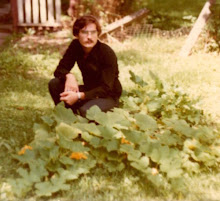
Hankering (summer haiku)

In February, in this part of the world, the light has returned but the warmth remains remote. It is perhaps no wonder that the summer-themed haiku are written during the cold of winter. Gazing out the window upon the skeletal twigs, one leaps over buds and shoots of spring to the fullness of bloom and leaf. One holds in mind the gardener's triumph. Later there will be satisfaction in the progressions; now is the time of the recollection of grand delight.


fence-clematis dots
found in formations
as sky-crisp as flocks


In the muffled muteness of the snow, it is difficult to hold true to the constant mutability. Difficult but not impossible especially with the help of words and images.

And so for day 424
10.02.2008

Broken on Purpose

The chapter on "Perfection" in David Weinberger Small Pieces Loosely Joined


No, we don't think we're perfect, but we think it's just a matter of time before progress will protect us from every random misfortune to which our flesh is heir. Where once our imperfection defined who we were as creatures, now it merits a shrug of the shoulders followed by an uplifting thought and a comment to maintain our all-important "self-esteem."


Now we come back to the Web. [...] The Web is broken on purpose.


I like how the theme of the robustness of the organic is introduced and undercut. Shrugging off imperfection is in a sense belittling its being a sign of the power to meet contingencies. Weinberger doesn't explicitly state the comparison of Web and human body. That is its charm, here.

And so for day 423
09.02.2008

Delight and Contemplation

Virginia Woolf's biography of Roger Fry of course quotes the painter and critic himself.


"One thing I can say for myself," he wrote. "There are no pangs of jealousy or envy when I see someone else doing good work. It gives me pure delight." There perhaps lay the secret of his influence as a critic.


Earlier, Woolf quotes Fry on his own painting ...


I shall never make anything that will give you or anyone else the gasp of delighted surprise at a revelation but I think I shall tempt people to a quiet contemplative kind of pleasure — the pleasure of recognising that one has spotted just this or that quality which has meaning tho' mostly one passes it by.


This approach is consonant with a critical practice of returning again to the picture (not claiming that one has exhausted all there is to see). It is an intensely scientific and patient approach. Being in touch with the variable. And the constant.

And so for day 422
08.02.2008

Rinse

I have encountered this advice about flatulence avoidance in a number of places. Kim Williams's is a simple and prosaic description of how to treat the cooking of beans. It is culled from the introduction to the recipe for "Savory Four-Bean Salad" found in her Cookbook & Commentary: A Seasonal Celebration of Good Food for Mind & Body.


With either method I drain off that soaking water, add fresh water, cook, covered, for one half hour, then drain again. Then I add fresh water and cook the beans until they are tender. This is the final cooking and the liquid stays with the beans.


Me, I discard the soaking liquid. Cook. Then discard the cooking liquid. And store with fresh water unless I am adding them immediately to a dish. Whatever the sequence of rinsing, a colander is a useful tool for cooking beans.

And so for day 421
07.02.2008

Listenings

From the interview with Monkey Bread, in the Daughters of Nzingha newsletter in the novel Mosquito by Gayl Jones.


Remember that listeners have got imaginations and sometimes their imaginations are richer than anything they can hear. Tell your stories right and the listener tells as much of the story as you do. Fact, the listener might tell the better parts of the story.


That little qualification "sometimes" opens the reader to a world of circumstance. Also if you read carefully you may stumble upon the concept that a single reader may have more than one type of imagination. Some of those imaginations see what is not heard.


And so for day 420
06.02.2008

Blue by Gass

To quote from On Being Blue: A Philosophical Inquiry by William Gass is to do an injustice to the text's voluptuousness, the waves of its pages. However to point people to it is a type of reparation.


Words are one-way mirrors, and we can safely breathe, hoot, holler all we like to assure ourselves of our existence, and never once disturb Prudence easing her itch.


And juxtaposing an earlier moment from the movement ...


None of these inclusive responses is purely public, purely private; each of them is cognitive, the sum of whatever we know and are at any moment. We experience the world, balanced on our noses like the ball it is, turn securely through the thunder of our own applause.


And so for day 419
05.02.2008

Sieve

There is an arresting description in Zen-Brain Reflections by James H. Austin that calls to mind over a wide arc of reading about the "Siena Sieve" portrait of Queen Elizabeth I that serves as a frontispiece to Lowell Gallagher's Medusa's Gaze: Casuistry and Conscience in the Renaissance. One mentions a sieve; the other depicts the monarch holding one.


The GABA cap can close and open, acting sometimes as a shield, sometimes as a sieve.


No other connection but the "sieve" as a concept or representation for the workings of the mind. And culinary memories of sifting or of draining, of actually shaking a sieve.

And so for day 418
04.02.2008

Psychosomatics and Ancestors

John Brunner Stand on Zanzibar. The novel's fiction. This exchange between characters spills out beyond the confines of the fictional world. Some of it seems to ring true for the actual world.


"[...] An old man — I suppose you'd call him a witch-doctor — taught me muscle-reading in the back streets of Port-au-Prince while I was ambassador to Haiti. I thought for a moment you must have suffered some sort of major injury to that hand, but I can't feel the effects of one. Whose hand was it, then?"

"My three times great-grandfather."

"Back in slavery days?"

"Yes."

"Cut off?"

"Sawn off. Because he hit his boss and knocked him into a creek."

"Elihu nodded. "You must have been very young when you heard about it," he suggested.

"Six, I think."


And the dialogue carries on. And far later in the novel, one character tells another:


In short, we're not expatriates, you and I. We're extemporates exiled from a country that vanished even before we were born, of which our parents made us citizens without intending to.


At this remove outside the fictional world I wonder if there is not a certain element of self-fashioning in the stories we assume. Not every bit of the past sticks. Is there not an element of choice in what is accepted out of time? Extempore?

And so for day 417
03.02.2008

Fate of Visions

Marcel Proust in "The Princesse de Guermantes Receives", Third Chapter of The Past Recaptured, translated by Frederick A. Blossom, on the fragility of memories and the affordances offered by nebulous recall


If I still possessed a copy of [...], I would never look at it; I would be too afraid of inserting in it little by little my impressions of today, covering completely those of former years; I would be too afraid of seeing it become so completely a thing of the present that, when I asked it to call forth again the child who spelled out its title in the little room at Combray, not recognizing its voice, he might not respond any longer to its call and might remain forever buried in oblivion.


The narrator had just before this called up an impression of how the mind works: "I know too well how easily the pictures left by the mind can be effaced by the mind." I stress the subjective position of this declaration and its focus on pictures not on moments of what we might call "bundles of experience." The pictures are fragile. They are things of the mind. The mind is ranked against its creations. "For the old ones it substitutes new ones which do not have the same power of resurrection."

This succession of selves and the theme of resurrection is set in the context of a contrast between a copy of a given book and the work itself. And in rereading (and thereby displacing some previous impressions or pictures) we discern almost the inverse of a labour theory of value. Rereading disturbs the work (i.e. the product). Rereading, an act of labour, destroys the talisman quality of the work, indeed destroys the work as product. The work might no longer serve in conjuring the picture of the child that was.

There is an escape from resurrection. There is the call of oblivion. It may call forth something more enduring. A few pages later the lament for the present's encroachment upon the past gives way to a passage that invites the reader to be mindful:


An hour is not merely an hour. It is a vase filled with perfumes, sounds, plans and climates.


And so the narrator moves from contemplating the role of reader to embracing the role of writer.

And so for day 416
02.02.2008

Visions of Fate

Stephen Kuusisto in Planet of the Blind muses upon fate and gives it a vibrant texture.


Fate it seems is made of thorns and blossoms and bones. As Corky [the guide dog] flings leaves and growls with satisfaction I contemplate gloom. The future is indifferent to emotion: events unfold with or without our melancholy or optimism. But there must be sufficient reason for optimism, and for the sentiment that we can craft our potential lives.


Sufficient but not necessary. We in this view of fate are cast back upon our resources. This is good and necessarily so.

He writes earlier in the book:


We are, all of us, ecstatic creatures, capable of joyous mercy to the self and to others.


To begin to think of mercy as a sentiment, it certainly helps to describe it as joyous. A very wise place from which to begin to craft our potential.


And so for day 415
01.02.2008