Showing posts with label verum factum. Show all posts

Knowing Making Telling

Matthew Kirschenbaum
Am I a Digital Humanist? Confessions of a Neoliberal Tool

"To the scholarly mind, every [sic] smallest datum of that inheritance has a right to make its call." In this McGann seems to follow Edward Said, who in Humanism and Democratic Criticism glosses Giambattista Vico’s famous verum factum principle — Vico is a touchstone for McGann too — as something like "We can really only know what we make" and "To know is to know how a thing is made, to see it from the point of view of its human maker." This ethos —  and the commitment to the arts of memory —  has become, as UVA’s Richard Rorty was wont to say, a part of my final vocabulary. I believe it is true, in so far as anything in this world is true, whatever epistemic frames might be thrown around it notwithstanding. It’s not that either the scholar’s art or the verum factum are sufficient on their own —  there are all sorts of considerations and contexts we want and need to bring bear — but this is where I start from. If it falls suspect to an ideological litmus test, if the space it opens for resistance or critique is insufficiently pure, then that’s it; I’ve got nothing left; I’m out of "moves." Better scholars and better players of the game than I have left it all on the field at that point. I’m off to go take a shower.

Or else I could just tell you a story.
I like the shift to simply telling a story which of course is another type of making.

And so for day 2175
26.11.2012

How inexhaustible is the human mind?

This passage from Northrop Frye strongly suggests the verum factum principle of Vico that links the true and the made.

Truth is always a beginning; it can never be the end of anything in this world, for there is no end it can come to except the mind in which it began. When the reason discovers a rational order in the universe; when the artist discovers that the world is beautiful, these discoveries are partly a matter of falling in love with one's own reflection, like Narcissus. Even when submarines swim under the pole and rockets circle the dark side of the moon, it is still the shadows of truth that are outside us; the substance is in ourselves. It is not the world that we contemplate but the world that we create which is important to us. The sources of creative power in the human mind are inexhaustible. If we could realize that they are infinite and eternal as well, and that the human mind is therefore linked in its nature and destiny with a divine mind, that would be the final motive for learning and the final guarantee of its value.

From By Liberal Things [his address upon his installation as Principal of Victoria College, 1959]
The tautology rests on the distinction between the created and the contemplated. A phenomenologically inclined view would be less easy with the separation. Perception is in part a power of filling in what is there. And is in part limited.

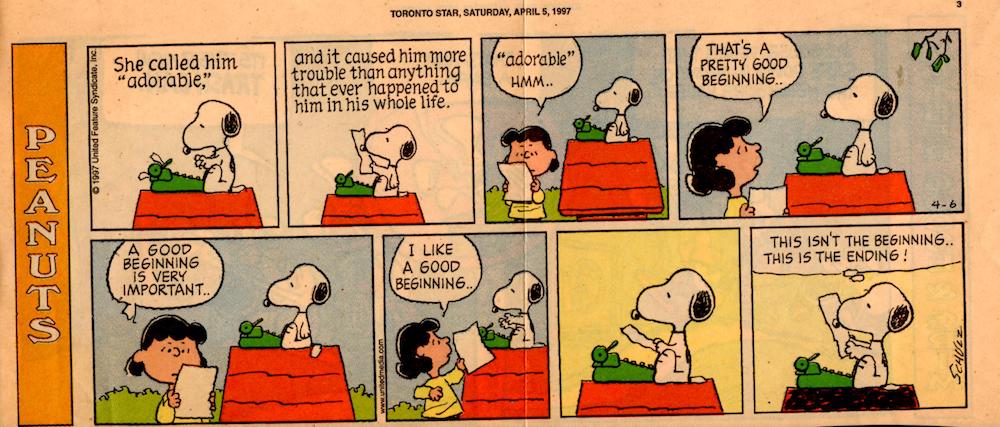
Though Frye begins and ends in the infinite and the divine, there are other ways to square the circle and find reason for human humility. Take this example offered by Charles M. Schulz in Peanuts where our characters have a different take on what constitutes a beginning.

And there is no telling which came first in my encounters: Frye or Schulz. Or in your reading.

And so for day 2156
07.11.2012