Showing posts with label found poem. Show all posts

Flavour Listings

Where taste begins with names.

CXBO

Strawberry, Earl Grey Tea
Spruce Mint
Cranberry, Ginger
Butterscotch
Peppermint, Cheesecake
Rosemary, Orange
Sugar Plum Jelly
Cherry, Marzipan
Coffee, Cinnamon
Yuzu, Sake
Sherry, Milk Chocolate
Pistachio, Bergamot
Orange Blossom, Honey
Cinnamon, Brown Butter
Cherry, Vanilla
Raspberry Rose Fennel
Lime, Ginger, Black Pepper
Salted Caramel

Names for chocolate bonbons - Names for flights of imagination.

And so for day 2373
12.06.2013

Magnifying Portions or Reading The Red Blind

I needed a magnifying glass because the weight of the typeface lent a blurring affect given the tight leading.

Some lines that take on a metatextual twist.
Them's the brakes. Care gives in to bebop pleasure.

Use a concept to pull the hat out of the rabbit.

Don't be a harness for your own dreams.
Greg Evason
The Red Blind
Toronto: The Pink Dog Press, 1991

True printing craftsmanship in producing a chapbook on the long end of 8 1/2 x 11 paper in one signature stapled in the middle. Book design by Kevin Connolly, the founder of Pink Dog Press.

And so for day 2357
27.05.2013

Interstitial

If there is any doubt about the technical term "bearing down" it would be dispelled by one look at the cover of Penny Chalmers (Penn Kemp) Bearing Down (Coach House Press, 1972).
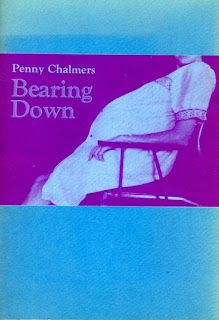
cover of bearing down

It is of course about the joys and tribulations of giving birth. But it is birthing in a particular space: the institution of the hospital. At the end of the book, there is a reproduction of a menu. It is obviously Easter time.
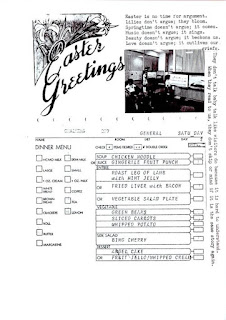
menu bearing down
In the upper right corner are some thoughts of the season (unattributed)
Easter is no time for argument.
Lilies don't argue; they bloom.
Springtime doesn't argue; it comes.
Music doesn't argue; it sings.
Beauty doesn't argue; it beckons and points.
Love doesn't argue; it outlives our griefs.
Which thanks to the World Wide Web we can ascribe to Frederick B. Speakman, author of sermons, in fine fettle for presenting an argument ("Easter is no time for argument" is itself an argument).

Down the right margin in landscape orientation is the a comment (we are uncertain in whose voice) it appears elsewhere as attributed to Patsy Gray (Age 9) from a piece about grandmothers:
They don't talk baby talk like visitors do because it is hard to understand.
When they read to us, they don't skip or mind if it is the same story again.
There are are more reproductions of hospital literature from the chaplain this time in which are interpolated other bits of unattributed sentimental poetry. For example
Said the Robin to the Sparrow:
"I should really like to know
Why these anxious human beings
Rush about and worry so.["]

[which we trace to Elizabeth Cheney]
Both the hospital literature and the interpolations are in Courier, the ubiquitous typewriter typeface. We are faced with the question: did the poet place these in the spaces or were they found there? The one clue, layout of the interpolations in a perpendicular position, doesn't apply to all the space cramming instances. All do share a crowding effect. There is quoting going on. Who is doing it remains uncertain. I vouch for ironic insertions by the author given the wry wit exhibited in a number of the birth poems all the while bearing down.

And so for day 2239
29.01.2013

Egg-centric concrete found poem

From the bookstore Good Egg in Kensington Market, a receipt that provides a little graphic oval. A nice touch.

good egg receipt


And so for day 2200
21.12.2012

Claim and Less

Tim Cestnick writing in The Globe and Mail provides us with a found poem. The list has enormous poetic potential (imagine for example the mere recitation of names (from an old-fashioned telephone book) — very Homeric). And this list culled from an entry about medically expenses (not) eligible for tax purposes bring us into the ambit of the body in its vulnerability.

Medical expenses. The problem here is that, while the list of eligible medical expenses is growing slowly, there’s still much that can’t be claimed – and people push the boundaries. You can’t claim the costs of practitioners not recognized by your applicable provincial authority. Nor can you claim vitamins, natural supplements or over-the-counter medications, recliners, non-hospital beds and certain supplies such as rubbing alcohol, bandages and shoe inserts.
See what happens with some lineation:
  • vitamins
  • natural supplements
  • over-the-counter medications
  • recliners
  • non-hospital beds
  • certain supplies
    • rubbing alcohol
    • bandages
    • shoe inserts
The jumble remains a jumble. But the sub-list takes on the impression of a tour of the drug store for the supplies that help the hapless suffer through the quotidian. The list is leached of its specialness. Its elements are common. Difficult to justify which as Cestnick writes is the problem here. The lasting impression is of the mock-heroic.

And so for day 2136
18.10.2012

Terms - Plucked and Gathered

DWR trawling through John Williams's Augustus recorded these on a slip

Tautened
Tongue
Tension
The image is particularly haunting because it communicates with a certain eloquence a certain lack of facility with language — a palpable tension.

And so for day 2116
28.09.2012

Scholarship and Cosmos

From nine first lines

The light foot hears you at the edge
Thickened light and liquid earth
Grail quests in times of plague
Instabilities of interminable
Fiery inclinations toward obscure
Indications of ripened peaches
The light at the end of unforeseen
Circulations of vanishing conversations
Protean racket intercessions were always
Nine Blue Moments for Robin. Michael Boughn

And here is a piece from the seventh of these homages to Robin Blaser
[…]
ashes. Peacock flesh from old
poems preens in reflections flashing
with clearly discerned intrusions
of glory eruptions eschewing
finely boned displays of self
determined perfections for the sheer
joy of raunchy instigations
and unheard of worlds written
asunder.
[…]
The line breaks and enjambement along with the diction and vocabulary evoke what is elsewhere in the suite of poems referred to as "scholarship and cosmos teeming / with the sense of a kiss that never / quite ends because its beginning / was impossible".

And so for day 2014
18.06.2012

Piscine Delights

From the Glossary of Fish Names in Jane Grigson Fish Cookery

Nannie Nine Eyes (sea lamprey: eel)
Nanny nose (soft clam)
Nanny shad (gizzard shad; shad)
Nassau grouper (grouper)
Native oyster (oyster grown in UK, Ostrea edulis)
Navaga (cod)
Pure Found Poetry

And so for day 1906
02.03.2012

Morphemes Metastasize

pages and pages apart is found a description to describe language under pressure

The wire, the wire, the why are, the why are. The why are we here? Listen there was time.
which instantiates what our poet earlier expressed in a finely allitertive phrase: "tumorousness of nurture"

Sina Queyras Lemon Hound

And so for day 1858
14.01.2012

Make Space for the Girl

Found poem.

I've come from him
and how close to me
he remains.

someone, somewhere,
will look for me and
I will be found
From trans poet, Gwen Benaway Passage.
First stanza is the last stanza of "Nightfall" p. 69
Last stanza is the last stanza of "What's Wild in Wild" p. 21

What is ostensibly a "him" referring to the lost ("divorced") lover is inscribed in such a way to reveal an intriguing (unconscious) introversion of the mourned object: "in cold light, a marker for how far // I've come from him / and how close to me / he remains" — that gap produces a displacement if not condensation of the signifier — another him may be lost.

Thomas Pavel, Fictional Worlds
[T]here is no guarantee that all sentences of the text can be traced back to one and the same world, or to the same universe.
And as we learn here, pronoun reference can shift. Pavel reminds us "referential behavior includes a creative, risk-taking aspect, as well as a tendency to settle down into conventional patterns."

And so for day 1839
26.12.2011

Reading the Index Finding Treasure

In these days of full text searching, the reading of indices is no longer an habitual activity. It is not however difficult to appreciate the indices prepared with the care and preserved in tomes such as The Book of Knowldge: The Children's Encyclopedia Volume XX (1929).

Following on the standard alphabetical index and the poetry index (by author and first lines), is the "School-Subject Guide" which has an "Applied Science and Industry" section which has as its first subsection one devoted to "Food and Its Sources". Its listing reads like a found poem.

A Grain of Salt
How Coffee Comes to Us
How Fish and Oysters are Taken
How Flour is Made
The Story in a Tea-cup
Where Sugar Comes From
The Worlds' Bread and Butter
Bees and Wasps (The makers of the purest sugar)
Crabs, Lobsters and Their Kin
The Great Cattle Family (Animals that feed and clothe us)
[...]
The "Food and Its Sources" subsection continues with a list of Things to Make which references recipes and experiments found throughout the volumes of the encyclopedia and that listing is followed by Wonder Questions.
What makes us hungry?
Does the brain need food?
Why do we cook our food?
[...]
Trolling through the index is like reading a map, imagining where to go. With Volume and Page Number functioning like a URL. And easily absorbing time and attention.

And so for day 367
16.12.2007